By Ago Kitchens · Published
This is general guidance about countertop materials, whoever you hire. Individual products and slabs vary, so always check the manufacturer's care and warranty information for the specific material you choose.
At a Glance
| Attribute | Quartz | Granite | Laminate |
|---|---|---|---|
| Made from | Ground quartz bound with resin | Natural quarried stone | Decorative layers over a wood-based core |
| Hot pans | Use trivets; resin can be damaged by heat | Tolerates heat better; trivets still advised | Can scorch or blister |
| Stains | Non-porous; resists stains | Varies by stone; some absorb oils and liquids | Surface resists stains |
| Sealing | Not needed | Depends on the stone | Not needed |
| Water at seams and edges | Not a concern for the material | Not a concern for the stone | Can swell the core if water gets in |
| Undermount sink | Common | Common | Usually drop-in |
| Repairs | Chips can often be filled by a fabricator | Chips can often be filled by a fabricator | Damaged sections are usually replaced |
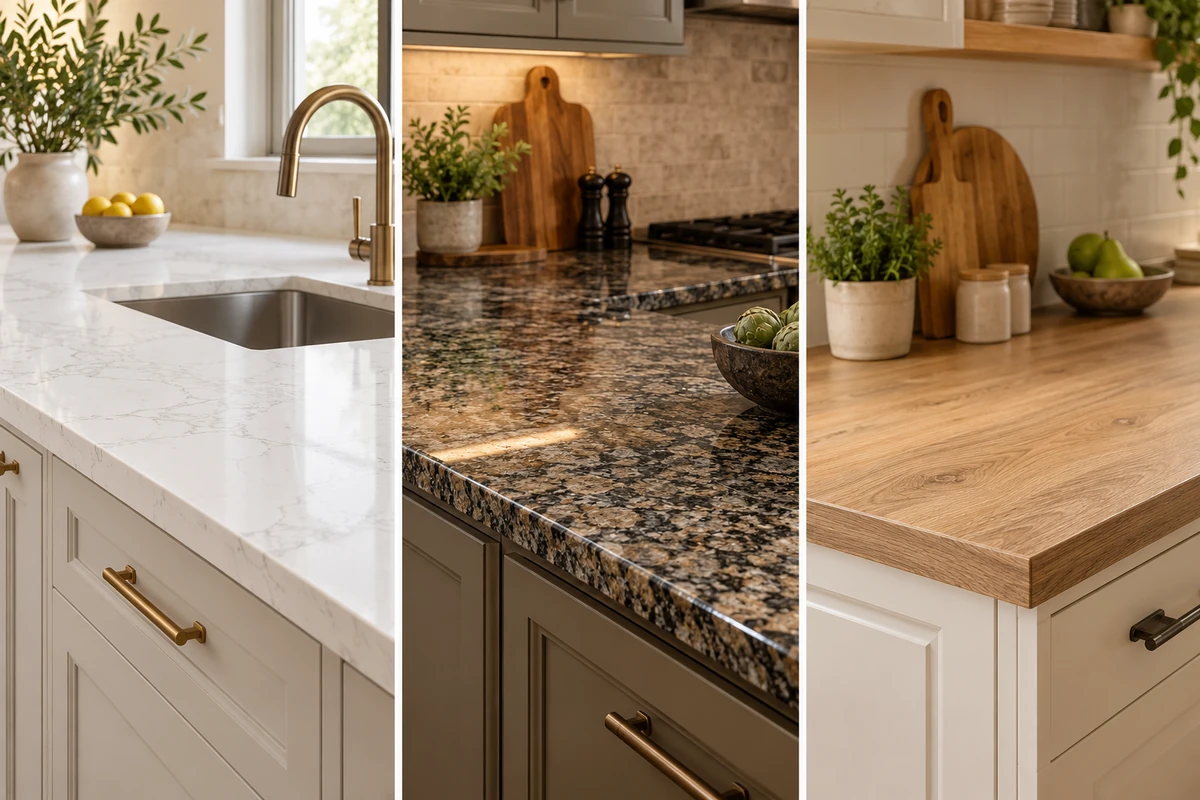
| Look | Consistent color and pattern | Every slab is unique | Wide range of printed patterns |
What Each Material Is
- Quartz is engineered stone: mostly crushed natural quartz bound with polymer resins and pigments, then formed into slabs. The resin is what makes it non-porous, and also what makes it more sensitive to heat than natural stone.
- Granite is natural stone cut from quarried blocks. In the countertop trade, "granite" often covers a range of natural stones with different hardness and absorbency, which is why care advice varies from slab to slab.
- Laminate is a thin decorative surface — printed paper layers saturated with resin and pressed under heat — glued to a particleboard or MDF core. The surface is tough; the core is the weak point if water reaches it.
Heat
None of the three is heat-proof. Quartz manufacturers' care guidance — for example Caesarstone's — calls for trivets or hot pads under hot cookware, because high heat and sudden temperature changes can discolor or crack the surface. Granite tolerates heat better, but trivets are still sensible, especially near seams and repairs. Laminate is the most heat-sensitive: a pan straight from the burner or oven can scorch or blister it.
Stains, Water, and Sealing
Quartz and the laminate surface are non-porous and do not need sealing. Granite varies: the Natural Stone Institute notes that many granite countertops do not strictly need sealing, though many benefit from it because a sealer reduces how much liquid the stone absorbs. Wiping up oils, wine, and coffee promptly matters more for porous stones.
For laminate, the concern is water rather than stains. Standing water at seams, along the backsplash, or around a sink cutout can reach the core and cause swelling or lifting, so seams should be tight and spills wiped up.
Scratches, Chips, and Repairs
- Quartz and granite resist scratches from normal use, but edges and corners can chip from a heavy impact. Small chips can often be filled and polished by a fabricator.
- Laminate scratches and cuts more easily, so cutting boards are a must. Burns, deep cuts, and swollen areas generally cannot be repaired invisibly; the section is usually replaced.
Simple edge profiles such as eased or square edges are the most chip-resistant on stone and quartz.
Appearance and Consistency
Quartz looks the same from sample to installed slab, which makes it predictable for large or matched areas. Granite is the opposite: color and veining vary within and between slabs, so viewing the actual slab before fabrication avoids surprises. Laminate offers the widest range of printed colors and patterns, including stone and wood looks; its seams and edges are usually more visible than on stone.
Sinks, Edges, and Seams
- Sinks. Quartz and granite commonly use undermount sinks, which make wiping crumbs into the sink easy. Laminate usually uses drop-in sinks.
- Seams. Slabs and sheets have maximum sizes, so long or L-shaped counters may need seams with any material. Ask where seams will fall — away from the sink and cooktop is usually best.
- Edges. Stone and quartz edges are shaped during fabrication. Laminate edges are either wrapped in one piece (postformed) or finished with a separate edge strip.
Weight and Installation
Quartz and granite slabs are heavy. Base cabinets need to be level, sound, and securely fastened, and stone tops are usually templated after the cabinets are installed, then fabricated. Laminate is far lighter and often comes in standard lengths or is fabricated to size. Our countertop installation page explains how a replacement typically proceeds.
Everyday Care
- Quartz: mild soap and water; avoid harsh chemicals and abrasive pads that can dull the surface.
- Granite: mild, pH-neutral cleaners; avoid acidic or abrasive cleaners; reseal if the stone starts absorbing water.
- Laminate: mild soap and water; avoid abrasive pads and harsh drain or oven cleaners; keep seams dry.
Which Suits Your Kitchen?
- A busy household that wants low maintenance: quartz — no sealing and strong stain resistance, as long as hot pans go on trivets.
- Frequent cooks who set hot cookware down: granite tolerates heat best of the three, with sealing as the trade-off for some stones.
- A one-of-a-kind natural look: granite, chosen from the actual slab.
- A tighter budget or a short-term refresh: laminate is generally the least expensive of the three, with a drop-in sink and extra care around water.
- An undermount sink: quartz or granite.
Price depends on the specific product, slab grade, thickness, edges, cutouts, and seams, and quartz and granite overlap widely. We do not publish countertop prices; our cost guide explains the factors.
Frequently Asked Questions
Is quartz the same as quartzite?
No. Quartz countertops are an engineered product made mostly of ground quartz bound with resin. Quartzite is a natural stone, quarried and cut into slabs like granite. They look similar in some colors but are cared for differently, so confirm which one you are being shown.
Can laminate countertops have an undermount sink?
Standard laminate tops are usually paired with drop-in sinks, because the cut edge around an undermount opening exposes the core to water. If an undermount sink matters to you, quartz, granite, or solid surface are the more common choices.
Does granite need to be sealed every year?
Not necessarily. Granites vary widely in how much they absorb. A simple water test — a few drops left on the surface for several minutes — shows whether a spot darkens. Ask the fabricator what your specific stone needs.
Which is easiest to keep clean?
Quartz and laminate need only mild soap and water and no sealing. Granite is also easy day to day, but some stones need periodic sealing, and harsh or acidic cleaners can dull the finish or wear down a sealer.
Choosing for Your Kitchen
Samples look different under your own lighting and next to your cabinets and floor. Ago Kitchens offers countertop installation in Owatonna and nearby communities; to talk through your options, call and see how a project starts.