Our Backsplash Installation Service
Ago Kitchens installs kitchen backsplashes as a project on its own or together with new countertops, refinished cabinets, or a full kitchen remodel. The material, layout, and scope for your kitchen are discussed during the on-site consultation and set out in your written estimate, and your agreement is directly with Ago Kitchens.
The rest of this page is general information about kitchen backsplashes to help you plan, whoever you hire. It is not a quote, and it does not describe a specific Ago Kitchens project or the specific materials available for yours.
When to Replace a Backsplash
- New countertops. Removing old countertops often damages the bottom row of an existing backsplash, and a new top may not match the old tile's height.
- A dated or damaged surface. Cracked tile, stained grout, or a painted wall that is hard to clean behind the range.
- A cabinet refresh. A new backsplash is a common companion to refinished or refaced cabinets.
Backsplash Materials
| Material | Strengths | Watch for |
|---|---|---|
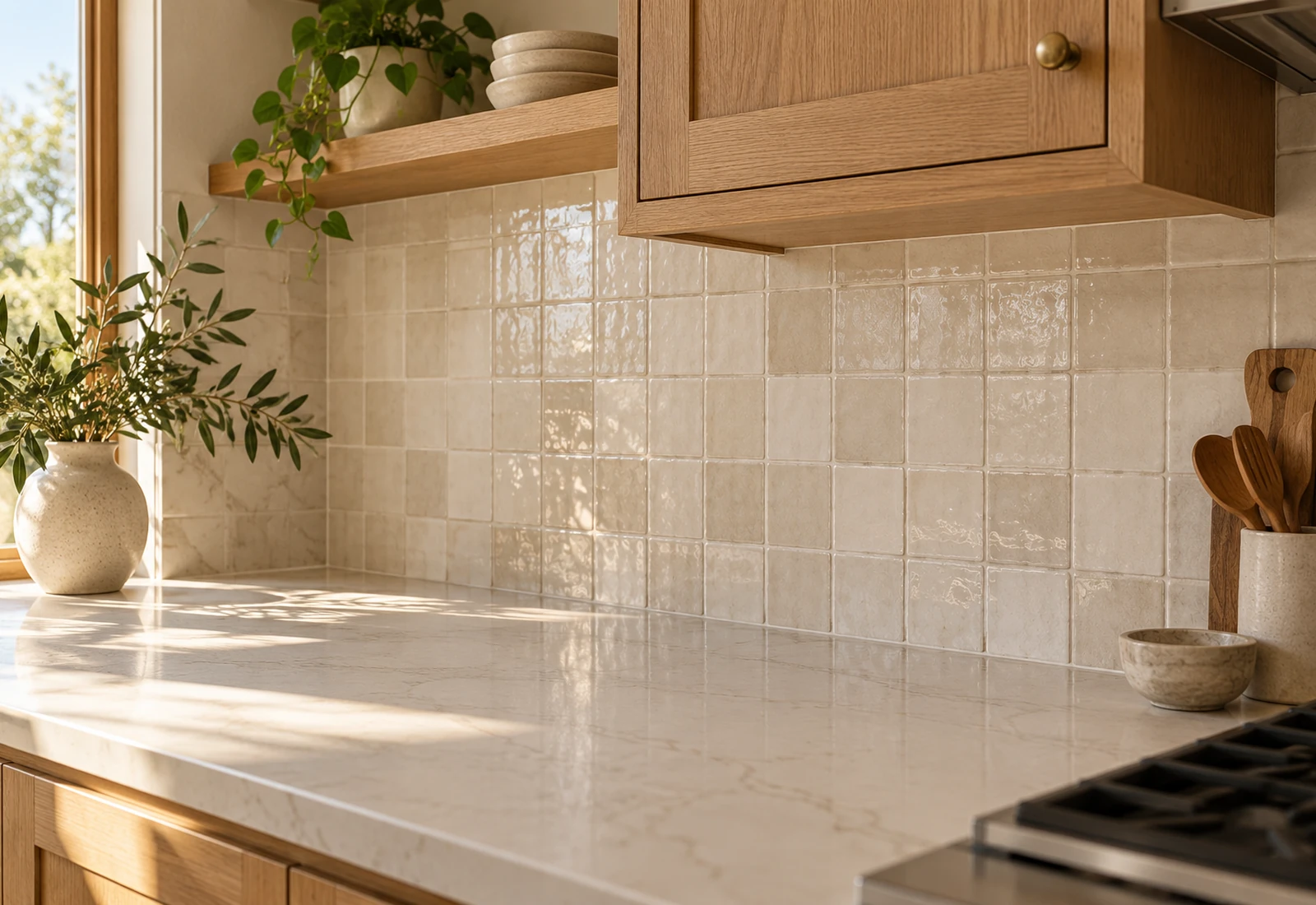
| Ceramic tile | Wide range of colors and shapes; easy to clean | Glaze quality varies; handmade-look tile has more size variation |
| Porcelain tile | Dense and stain-resistant; large formats reduce grout lines | Large tiles need a flat wall to avoid uneven edges |
| Glass tile | Reflects light; easy to wipe down | Shows the adhesive and wall behind it if not installed carefully; edges need finishing |
| Natural stone tile | Texture and natural variation | Usually porous; needs sealing and gentle cleaners |
| Full-height slab | Continuous surface, often matching the countertop; minimal grout | Heavier and fabricated to measure, like a countertop |
Behind a range, choose a material that is easy to clean and tolerates heat; the area behind a gas cooktop in particular sees grease and high temperatures.
Height, Layout, and Pattern
- Stopping points. Decide where tile ends at open walls, windows, and the sides of the upper cabinets, and how edges will be finished (bullnose tile, metal trim, or a finished edge).
- Pattern. Running bond (the classic subway layout), stacked, herringbone, and vertical layouts change the look as much as the tile does. Diagonal and herringbone patterns take more cutting and more tile.
- Centering. Laying out the pattern around a focal point, such as the range or a window, avoids thin slivers of tile in visible places.
- Setting material. Tile is set with a thinset mortar or, for some small ceramic tile on dry walls, a premixed adhesive. Glass, natural stone, and large-format tile generally call for a thinset suited to that tile — the tile manufacturer's instructions decide. Ask what will be used.
- Extra tile. Ordering extra for cuts and breakage, and keeping a few spare tiles for future repairs, is common practice.
Grout, and Where Tile Meets the Countertop
Grout color changes the look: contrasting grout highlights the pattern, while matching grout reads calmer. Cement-based grouts are common and usually need sealing; epoxy and other high-performance grouts resist stains better. Ask which grout is proposed and how to care for it.
Where the backsplash meets the countertop — and at inside corners — tile industry guidance from the Tile Council of North America calls for flexible sealant joints rather than grout, because the surfaces move slightly. A sealant joint at the countertop is a sign of correct practice, not a shortcut.
Outlets and Switches
Kitchen countertop outlets usually sit in the backsplash. Plan their positions so cover plates land neatly within the tile layout, and expect outlet boxes to be adjusted so they sit flush with the new surface. Countertop outlets must have ground-fault (GFCI) protection under the electrical code. Moving or adding outlets is electrical work, which in Minnesota must be done by appropriately licensed electricians.
How Backsplash Installation Typically Works
- Layout and ordering. Tile, trim pieces, and setting materials are chosen and ordered.
- Wall preparation. Old backsplash is removed if needed, and the wall is repaired and made flat and clean.
- Setting tile. Tile is set to the planned layout, with cuts around outlets, windows, and cabinets.
- Grouting and sealing. Joints are grouted, sealant is applied at the countertop and corners, and stone or grout is sealed if required.
- Finishing. Cover plates are reinstalled and edges are trimmed.
What Affects a Backsplash Estimate
- Square footage and how far the tile extends (to the cabinets, to the ceiling, behind the range)
- Tile size, material, and pattern — small mosaics and herringbone take more labor
- Removal of an existing backsplash and wall repair
- Edge trim, grout type, and sealing
- The number of outlets, switches, and windows to cut around
We do not publish backsplash prices. Our remodel cost guide explains how finishing elements add up in a kitchen budget.
Backsplash FAQs
Should the backsplash go all the way to the ceiling?
Most backsplashes run from the countertop to the underside of the wall cabinets. Where there are no upper cabinets — behind a range hood or on an open wall — tile is often extended to the ceiling or to a natural stopping point such as a window edge. Decide the stopping points before tile is ordered.
Should I install the backsplash before or after new countertops?
After. The backsplash sits on the finished countertop, so new tops go in first. If you are replacing both, plan them together — see countertop installation.
Why is there caulk instead of grout where the tile meets the countertop?
The joint where the wall meets the countertop is a change of plane where the two surfaces can move slightly. Tile industry guidance calls for a flexible sealant there rather than rigid grout, which tends to crack at that joint.
Can new tile go over my old backsplash?
Sometimes, but it adds thickness that can leave outlets recessed and edges that need trim, and it depends on the condition of what is underneath. Many installers prefer to remove the old backsplash and repair the wall. Ask what is recommended for your wall.
Getting Started
Call Ago Kitchens at 877-708-4271 to talk about kitchen backsplash installation, on its own or as part of a larger kitchen project. After an initial project discussion, an on-site consultation looks at your kitchen in person, and you receive a written estimate. If you decide to go ahead, you sign a written agreement directly with Ago Kitchens before work begins — see how it works.
We work in Owatonna and in Medford, Faribault, Waseca, Blooming Prairie, and Austin. See service areas for the communities we cover.