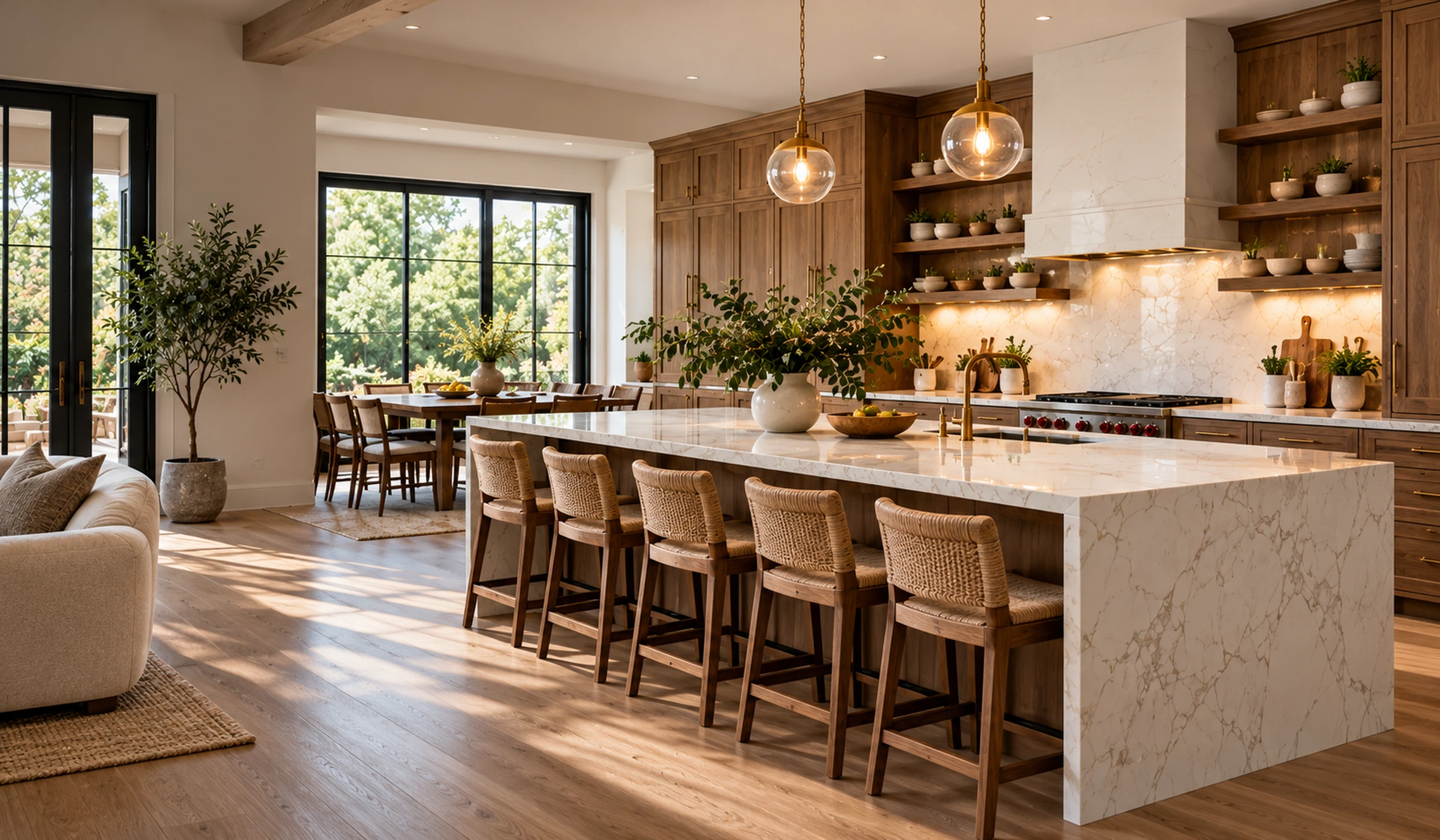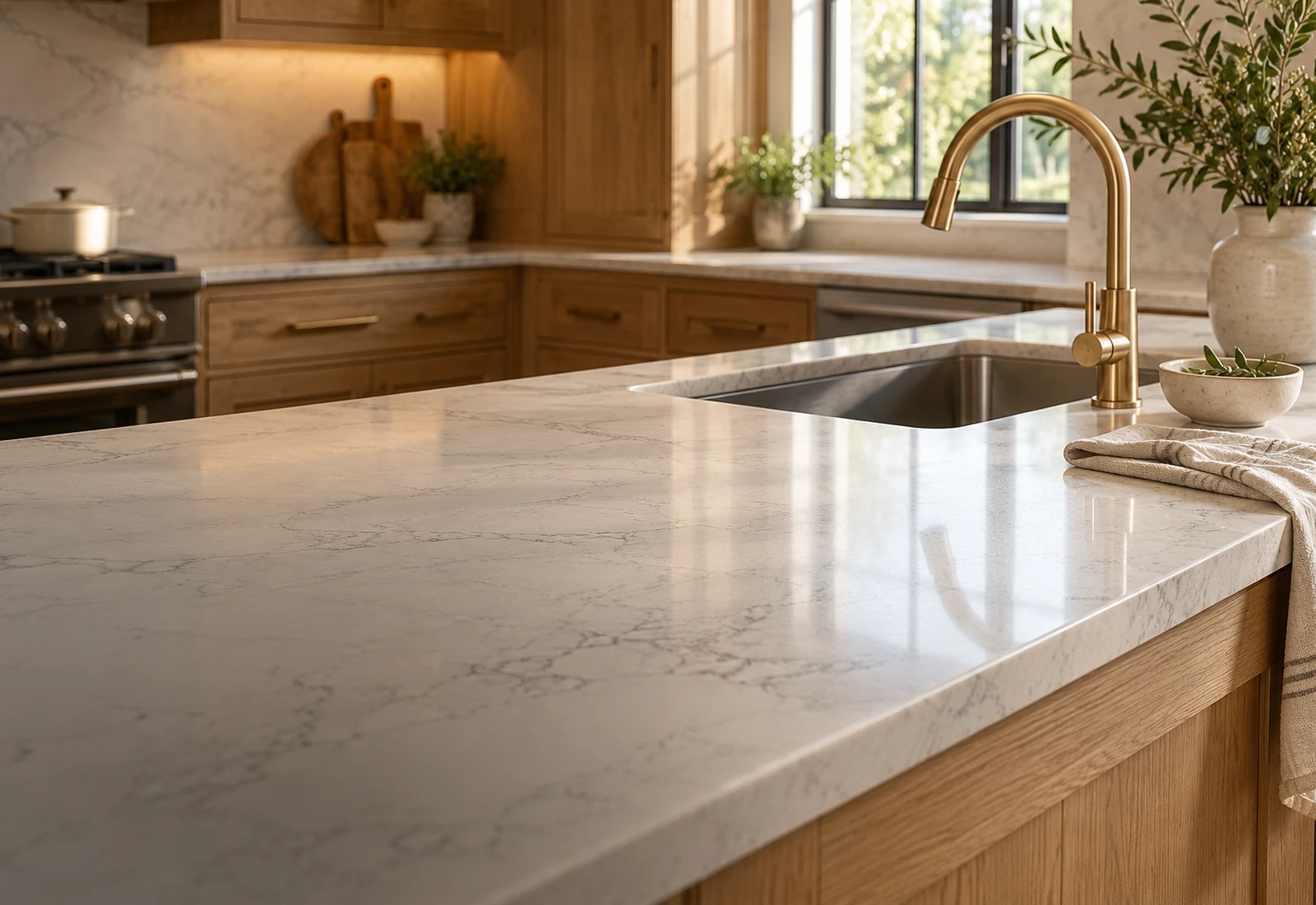
Our Countertop Installation Service
Ago Kitchens installs kitchen countertops as a project on its own — when the cabinets and layout still work — or as part of a full kitchen remodel. The material, edge, sink, and scope for your kitchen are discussed during the on-site consultation and set out in your written estimate, and your agreement is directly with Ago Kitchens.
The rest of this page is general information about countertops to help you compare options, whoever you hire. It is not a quote, and it does not describe a specific Ago Kitchens project or the specific materials available for yours.
When Replacing Countertops Makes Sense
- The surface is failing: chipped or delaminating laminate, burns, deep stains, or cracks around the sink.
- The cabinets are still good: a new top is one of the most visible changes you can make without changing the layout.
- You need a different sink or cooktop: an undermount sink, for example, generally needs a solid material such as stone, quartz, or solid surface rather than standard laminate.
- You are changing the cabinets anyway: new cabinets almost always mean new tops, since old tops rarely fit new boxes.
If the base cabinets are sagging, water-damaged, or out of level, fix that first — a new top will only be as flat and secure as what sits under it. Our cabinet installation guide explains what to look for.
Countertop Materials Compared
| Material | Strengths | Watch for |
|---|---|---|
| Quartz (engineered stone) | Consistent color and pattern; non-porous, so no sealing; resists stains | Resin binders can discolor or crack from direct heat; some colors fade in strong sun |
| Granite | Natural variation; tolerates heat well; durable | Every slab differs, so view the actual slab; many need periodic sealing |
| Marble | Classic veining; stays cool for baking | Softer; etches from acidic foods like lemon juice and vinegar |
| Quartzite | Natural stone, often very hard, with a marble-like look | Sometimes confused with softer stones sold under the same name; ask for testing or documentation |
| Solid surface | Seamless look; integrated sinks possible; scratches can be sanded out | Sensitive to heat and cuts |
| Laminate | Lowest material cost; many patterns | Seams and edges can swell if water gets in; usually limited to drop-in sinks |
| Butcher block | Warm look; can be sanded and re-oiled | Needs regular oiling; water near the sink can stain or warp it |
For a closer look at the three most common choices, see our quartz vs. granite vs. laminate comparison. Bring a sample home and look at it next to your cabinet finish, flooring, and backsplash in your own light. Materials chosen together look more deliberate than ones chosen one at a time.
Thickness, Edges, Seams, and Overhangs
- Thickness. Stone and quartz commonly come in about 2 cm (3/4 inch) and 3 cm (1 1/4 inch) slabs. Thinner slabs may need a plywood sub-top or a built-up edge.
- Edge profiles. Simple eased or square edges are the most chip-resistant and easiest to clean; decorative profiles such as ogee add fabrication work.
- Seams. Long runs and L-shaped counters often need seams because slabs have a maximum size. Ask where seams will fall before fabrication — away from sinks and cooktops is usually best.
- Overhangs. Seating overhangs on an island or peninsula need adequate support. Larger overhangs typically require brackets or corbels; ask what support the chosen material requires.
Sinks, Cooktops, and the Backsplash
Cutouts for the sink, faucet, soap dispenser, and cooktop are made during fabrication, so sink and cooktop models should be chosen — and their specifications provided — before templating. Undermount sinks are attached beneath the stone or quartz; drop-in sinks rest on top and work with more materials.
Removing an old countertop often damages the bottom of an existing backsplash, so many homeowners replace the backsplash at the same time. See kitchen backsplash installation for the options. Disconnecting and reconnecting plumbing, gas, or electrical connections must be done by appropriately licensed individuals in Minnesota.
How Countertop Replacement Typically Works
- Selection. Choose the material, color, edge, and sink. For natural stone, viewing the actual slab avoids surprises.
- Templating. Precise measurements or a physical template are taken from the installed cabinets.
- Fabrication. Slabs are cut, edged, and cut out for the sink and cooktop.
- Removal and installation. Old tops come out, new tops are set, leveled, seamed, and secured.
- Reconnection. The sink, faucet, and any cooktop are reconnected, and seams and edges are checked.
Lead times for fabrication vary with the material and season, so ask for a current estimate before planning around the kitchen being out of use.
What Affects a Countertop Estimate
- Material and the specific color or slab grade
- Total square footage and the number of separate pieces and seams
- Edge profile, thickness, and any built-up edges
- Number and type of cutouts (sink, faucet holes, cooktop)
- Removal and disposal of the existing countertops
- Whether a backsplash, sink, or plumbing reconnection is included
We do not publish countertop prices because they depend on these choices and your kitchen. Our remodel cost guide explains how countertops fit into a larger budget.
Questions to Ask About Any Countertop Estimate
- Which material, brand or stone, color, and thickness is included?
- Where will the seams be, and how will they be finished?
- Are removal, disposal, sink and faucet cutouts, and reconnection included?
- What care does this material need, and does it need sealing?
- What is the current lead time from templating to installation?
Countertop FAQs
Can I replace my countertops without replacing my cabinets?
Often, yes — if the base cabinets are level, solidly attached, and in good condition. Heavy stone and quartz need cabinets that can carry the weight, and removing old tops can expose wall damage or uneven cabinets that need attention first. If the cabinets are worn but structurally sound, refacing or refinishing them at the same time is a common pairing.
Which countertop material is most heat-resistant?
Natural stones such as granite tolerate heat better than most surfaces, but no countertop is heat-proof. Quartz contains resin binders that can discolor or crack from hot pans, and laminate and solid surface can scorch. Using trivets protects any material.
Do granite and marble countertops need sealing?
Many natural stones are porous and benefit from periodic sealing, but stones differ widely — some dense granites barely absorb anything. Ask what the specific slab needs and how to test whether it needs resealing. Quartz, solid surface, and laminate are not sealed.
Why is there a gap between cabinet installation and countertop installation?
Stone and quartz tops are usually fabricated from a template made after the base cabinets are installed and level, so the tops fit the actual cabinets and walls. Fabrication follows the template, which is why there is typically a wait between the two.
Will my sink and faucet need to be disconnected?
Usually. Replacing a countertop that holds a sink or cooktop means disconnecting and reconnecting plumbing, and sometimes gas or electrical connections. In Minnesota, plumbing, gas, and electrical work must be done by appropriately licensed individuals, so ask who will handle each connection.
Getting Started
Call Ago Kitchens at 877-708-4271 to talk about kitchen countertop installation, on its own or as part of a larger kitchen project. After an initial project discussion, an on-site consultation looks at your kitchen in person, and you receive a written estimate. If you decide to go ahead, you sign a written agreement directly with Ago Kitchens before work begins — see how it works.
We work in Owatonna and in Medford, Faribault, Waseca, Blooming Prairie, and Austin. See service areas for the communities we cover.